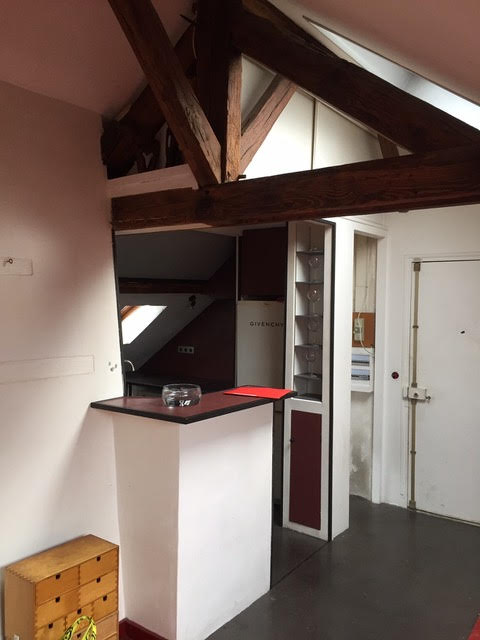
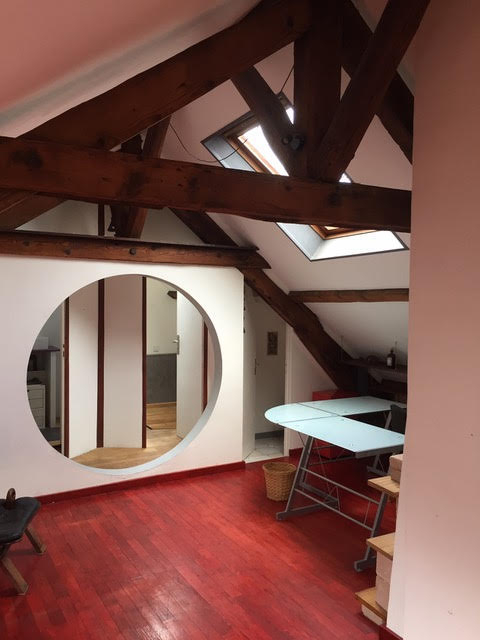
Olivier, the incognito journalist-owner of this Paris residence, describes his newly overhauled digs as “an surprising synthesis of Oscar Niemeyer’s French Communist Get together headquarters and my late grandparents’ home.” The 70-square meter (roughly 753-square-foot) area is located on the highest ground of a Nineteenth-century two-story construction that had been a milking parlor.
Eager to stay in a Paris suburb that hadn’t been “conquered by gentrifying strollers,” Olivier mentioned associates beckoned him to Saint-Denis and that his flat was the primary he checked out. Way back transformed to residing quarters, the residence was final occupied by somebody within the theater enterprise who launched its most outstanding characteristic: a virtually six-foot large porthole passageway. Different present particulars blocked the pure gentle and “lacked widespread sense.” Architects Suleïma Ben Achour and Antoine Lallement of Studio Classico have been employed to not solely treatment the structure, however to discover a place for Olivier’s books—”17 linear meters [55.7 feet] of them,” notes Suleïma—whereas lending the area an orderly, trendy really feel.
Be a part of us for a take a look at the outcomes, with nods all through to Olivier’s wide-ranging design references. Scroll to the tip for a glimpse of the historic construction and what the residence regarded like earlier than.
Pictures courtesy of Studio Classico (@studio_classico).
Dwelling Space
Above: The porthole divides the residence’s residing space and the bed room and tub. Studio Classico’s answer was to introduce a sliding bookcase that glides open to supply a “secret passageway” into the personal suite.
Above: The general public half of the residence is U-shaped with an open lounge on one facet, a compact kitchen on the opposite, and a eating desk within the center. The uncovered rafters are unique and together with the porthole are what bought Olivier on his place.Above: To lend the design softness and cohesion, the architects utilized curved traces that echo the porthole.
Above: The kitchen has a plywood and Formica counter with uncovered wooden edging and a washable canvas skirt. The tubular gentle is from Sammode Studio of Paris, which produces all of its designs in France.Above: Suleïma describes the design as “a Nineteen Seventies, quite simple kitchen that may resist developments and stains.” They tucked the fridge on the facet of the close by entry (see ground plan under) “with a purpose to have a really clear and linear countertop.” There are extra cupboards and a spread reverse the sink.Above: The porthole is seen from nearly all over the place within the residence.Ab0ve: The architects designed a built-in area of interest alongside the eating desk with “a closed cupboard with tempered glass to cover issues, and cabinets above to showcase lovely every day objects. This cupboard is reminiscent a little bit of Greek structure the place cabinets are constructed into lime plaster partitions.”
The orange Ra ceiling gentle is a 1969 Piet Hein design; the classic Rey chairs by Bruno Rey are again in manufacturing from Hay.
Above: The bookcases are product of stained pine plywood and simply slide to open. The prevailing ground was sanded and completed in “the colour of tatami mats.”
Bed room/Bathtub
Above: The en suite rest room is on the opposite facet of the divide—with sufficient clearance that, Suleïma assures, moisture just isn’t a difficulty. “I’ve a really sentimental relationship with books, and am unable to half with them,” says Olivier. “Being surrounded by books, whether or not novels, essays, picture books, or collections of poetry, stimulates my curiosity. It’s additionally a bit like residing in a home the place the furnishings is alive. Some folks do gentle remedy, I depend on the advantages of paper.”Above: The wall-to-wall carpeting within the en suite tub was impressed by Olivier’s grandparents’ Nineteen Seventies rest room and “provides to the feeling of getting handed into the personal sphere of the residence,” says Suleïma.
“I wished to interrupt away from the standardized bogs present in most new buildings,” says Olivier, noting that early within the undertaking Suleïma confirmed him Balineum’s line of tiles, and he fell in love with a checkerboard of Victorian-style Mottled Tiles and traditional Hanley Tiles with a canvas skirt just like the one used within the kitchen. The classic yellow plastic towel holders by Makio Hasuike add to the Nineteen Seventies undercurrent working by way of the residence.
Above: The Balineum tiles have been additionally utilized to the bathe ground. “The lavatory particulars are vital as a result of they’re the very last thing I see at evening and the very first thing I see within the morning,” says Olivier.Above: The gold carpeting from Balsan extends into the bed room, which has its personal built-in area of interest for books.
Ground Plan
Above: After we do inside renovations, we by no means have predefined types or colours we need to apply,” says Suleïma. “We, in fact, have references we love, however above all we need to spotlight the good issues which are already there. On this case, it was the attractive porthole and the timber body—which led us to think about the residence as a cabin monastery from the seventies.”
Exterior
Above: The historic construction is on a cobblestone avenue in Saint-Denis, one in all Paris’s northern banlieues. “After residing my youthful years in the course of the motion, my thirties have taught me that I really feel higher slightly extra out of it,” Olivier instructed us. “Saint-Denis has a nasty repute, however I’ve at all times liked its variety and wealthy historical past.”
Earlier than
Above L: The prevailing kitchen was wedged subsequent to the entry. Above R: “The porthole was already there in a non-aligned wall; we realigned it to reinforce the geometry,” says Suleïma.Above: The kitchen, says Olivier, “had pointless angles and the sunshine didn’t flow into because it ought to.” He was launched to Studio Classico, which is just two years previous, by way of a good friend: “I regarded fastidiously at their first initiatives and every time I mentioned to myself ‘I might stay right here’—the colours, the supplies, all the things spoke to me.”
We have now introduced nearly all of Studio Classico’s initiatives to this point: